What does NLP stand for?
NLP stands for neuro-linguistic programming. Each word names a layer the methodology works on:
- Neuro: the nervous system - sensory experience, internal imagery, body states.
- Linguistic: language, both external speech and the internal language we use to think.
- Programming: the way these neural and linguistic patterns are organized into repeatable sequences ("strategies") that produce behavior.
The premise is that thought, emotion, and behavior all run on patterns. Patterns can be observed, mapped, and changed. Change the pattern, change the result.
Who created NLP?
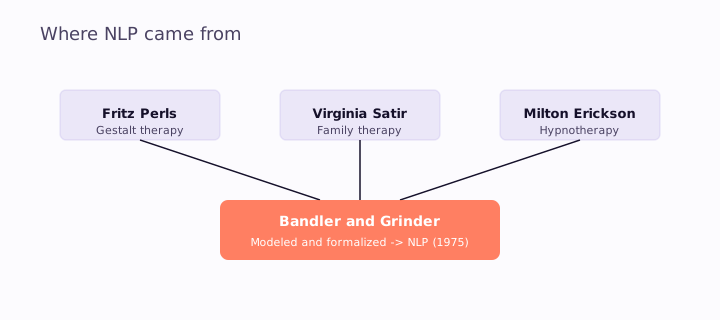
NLP was founded in the early 1970s by Richard Bandler, then an undergraduate at UC Santa Cruz, and John Grinder, an associate professor of linguistics. They studied three highly effective therapists - Fritz Perls, Virginia Satir, and Milton Erickson - and tried to extract what made their work effective. The patterns they identified became the first NLP techniques and were published in The Structure of Magic (1975) and Patterns of the Hypnotic Techniques of Milton H. Erickson (1975).
Other contributors shaped the field rapidly. Robert Dilts added the neurological levels framework and much of NLP's work on belief change. Tad James developed timeline therapy. Steve and Connirae Andreas systematized submodality work. Today the field is a loose federation of schools rather than a single discipline.
What are the core principles of NLP?
NLP runs on a set of working assumptions called the presuppositions. There are 15 in the canonical list, but five do most of the practical work:
- The map is not the territory. What you experience is a mental model of reality, not reality. Change the model and behavior shifts.
- People work perfectly. Every behavior, no matter how unwanted, is the best choice available given the person's current model.
- Every behavior has a positive intention. Even self-destructive patterns serve some need; work with the need, not against the symptom.
- There is no failure, only feedback. Missed outcomes are information about what to adjust, not evidence of incapacity.
- The meaning of communication is the response you get. If your message produced an unexpected reaction, that reaction is what you actually communicated.
What are the most common NLP techniques?
NLP's toolkit is large, but most working coaches use a small core regularly:
- Anchoring: linking a stimulus to a desired state.
- Reframing: changing the meaning or context of an experience.
- Submodalities work: adjusting the qualities of internal imagery to change how it feels.
- The swish pattern: replacing an unwanted automatic image with a desired one.
- Parts integration: resolving internal conflict between sub-personalities.
- The meta model: precision questioning that recovers deleted information in client language.
- The Milton model: artfully vague language that bypasses conscious resistance.
What is NLP used for today?
NLP shows up in five main settings:
- Coaching: confidence, performance, decision-making, relationships. Most working NLP practitioners coach.
- Sales and negotiation: rapport, language patterns, meta-programs. Often delivered as corporate training.
- Education: VAK matching, modeling, state management for learners and teachers.
- Therapy adjunct: some licensed therapists use NLP techniques (especially the fast phobia cure and reframing) inside a regulated clinical practice.
- Self-development: books, workshops, retreats aimed at the general public.
Is NLP scientifically valid?
The honest answer: partly. Some NLP concepts (the link between mental imagery and emotional state, the effectiveness of well-formed goal-setting, the role of rapport in influence) align with established findings in cognitive psychology. Other claims - especially around eye-accessing cues and rigid VAK profiles - have not held up under controlled studies. The field has been criticized for over-promising and for an evidence base that lags behind its commercial success.
Practical takeaway: treat NLP as a pragmatic toolkit, not a unified scientific theory. The techniques that survive in working practice survive because they produce results in coaching contexts. The ones that don't usually quietly fall out of use.
How do I learn NLP?
The standard path:
- Read a foundation book. Joseph O'Connor's Introducing NLP or Robbins's Awaken the Giant Within are widely used starting points.
- Take a Practitioner certification (7-15 days, in-person or hybrid). Choose a school certified by SNLP, INLPTA, ABNLP, or ANLP.
- Practice on real people with supervision. Skills do not develop from study alone.
- Take Master Practitioner (another 7-15 days) if you intend to coach professionally.
- Specialize. Pick a niche - executives, athletes, recovery - and apply NLP to it for at least a year.
Frequently asked questions
Is NLP the same as hypnosis?
No, but they overlap. NLP grew partly out of Bandler and Grinder's modeling of Milton Erickson, a hypnotherapist. NLP uses some hypnotic language patterns (the Milton model) but most NLP work happens in normal, alert conversation rather than formal trance.
Is NLP backed by science?
Some elements of NLP align with established findings in cognitive psychology and behavior change; others have not held up under controlled study. Modern practitioners treat NLP as a useful toolkit of pragmatic techniques rather than as a scientific theory of mind.
How long does it take to learn NLP?
A foundation Practitioner certification typically runs 7-15 days of training. Becoming genuinely skilled - the kind of skill clients pay for - usually takes 1-3 years of supervised practice on top of certification.
What is the difference between NLP and CBT?
CBT is a structured, evidence-based clinical therapy delivered over 8-20 sessions. NLP is a toolkit of techniques used in coaching, sales, and self-development, often in a single session or short engagement. CBT is regulated as therapy; NLP coaching usually is not.
Can I learn NLP from books alone?
You can learn the concepts from books. The skills - calibration, anchoring, rapport - require practice on real people with feedback from a trainer who can see what you're missing.
What is the best NLP certification?
There is no single answer. SNLP, INLPTA, ABNLP, and ANLP all certify competent practitioners; differences are mostly in curriculum emphasis, recognition in specific regions, and ongoing standards.
DIRECTORY
Ready to work with a certified trainer?
Search our verified directory by goal, specialty, and language.