What is an anchor in NLP?
An anchor is a stimulus that reliably elicits a specific internal state. The stimulus can be sensory in any channel: a touch on a knuckle, a particular word said in a particular tone, a mental picture, a smell. What makes something an anchor is the link: when the stimulus appears, the state appears with it.
Spontaneous anchors form constantly without intention. A song from a difficult year can drop you into the mood of that year the moment you hear it. NLP anchoring is the deliberate use of the same mechanism: install the trigger you want, attached to the state you want, on purpose.
How does anchoring work neurologically?
Anchoring is a close cousin of classical conditioning. The brain associates whatever stimulus happens to be present during an intense state with that state itself. The unique contribution of NLP is the recognition that the association can be installed in a single trial if three conditions are met:
- The state is fully elicited - physically embodied, not just talked about.
- The stimulus is applied at peak intensity, not before, not after.
- The stimulus is unique enough that it does not collide with everyday triggers.
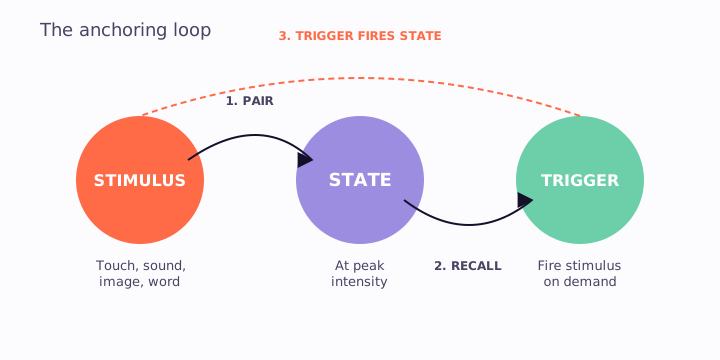
How do you set an anchor: 5 steps
- Choose the state. Make it specific - not "confidence" but "the calm focus I had during the second half of that race".
- Elicit fully. Walk the client through the memory in full sensory detail. Watch breathing and posture for the moment the state actually shifts into the body.
- Apply the trigger at peak. A unique touch (knuckle squeeze with a specific pressure), a word said with a distinct tone, or a self-administered gesture. Time it to the peak, not the climb.
- Break state and test. Ask an unrelated question to clear the state. Then fire the trigger alone. If the state returns, the anchor is set.
- Future-pace. Have the client imagine a specific upcoming situation and fire the anchor there. This generalizes the installation.
What is anchor stacking?
Anchor stacking compounds intensity by associating multiple instances of the same state with the same trigger. You elicit the state from one memory, fire the trigger at peak, release. Break state. Elicit from a different memory, fire the same trigger at peak, release. Repeat with three to five different sources. The single trigger now carries the combined intensity of every elicitation.
Stacking is what you reach for when a single elicitation produces a weak state, or when the client needs an anchor that holds up under real-world pressure.
What is a collapse anchor?
Collapse anchor uses two opposing anchors to neutralize a problem state. You set a strong positive anchor on one location (left knuckle, for example) and a moderate negative anchor on another (right knuckle). You fire them simultaneously. The nervous system cannot fully hold both states at once; the negative collapses into the positive, leaving neutrality or a resourceful response where there used to be a problem.
Common use: collapsing a fear-response anchor with a state of calm competence. The trigger that used to fire the fear no longer reliably retrieves it.
What are real-world examples of anchoring?
- Athletes: a pre-performance kinesthetic anchor (pressing thumb and ring finger) that fires the focused state from their best previous performance.
- Public speakers: an auditory anchor (a specific phrase said internally) fired before stepping on stage.
- People reducing alcohol: a collapse anchor that links a craving-trigger location to a state of resolved clarity.
- Therapists doing trauma adjunct work: a resource anchor the client fires before and after exposure to a difficult memory.
What can go wrong with anchoring?
- Weak elicitation. Talking about a state is not the same as being in it. If the body has not shifted, do not fire the anchor.
- Bad timing. Most failures come from applying the trigger past the peak. Watch the body for the climb and fire during it, not after.
- Generic trigger. A handshake or a regular finger snap will collide with everyday life and lose specificity. Use unique pressure, location, or a discreet combined gesture.
- Skipping the test. If you do not break state and fire the trigger alone, you do not know whether the anchor took.
- Anchoring negative states by mistake. If a client cycles into a problem state during the session, do not touch them in a unique way - you will inadvertently anchor the wrong thing.
Frequently asked questions
How long does an anchor last?
A well-installed anchor can last weeks to months, but its intensity fades with use. Fire it sparingly in real conditions and re-install during practice sessions. Anchors used daily for high-stakes moments hold up best with a weekly re-anchoring.
Can you set an anchor on yourself?
Yes. Self-anchoring works: recall a peak state in full sensory detail, apply a unique trigger at the moment of greatest intensity, release, break state, and test. Self-anchors are often weaker than coach-installed ones because it is hard to be both the eliciting party and the subject at the same time.
Why doesn't my anchor work?
The most common reasons: the state was not at true peak when the trigger fired; the trigger is not unique enough (you encounter the same touch in everyday life); the timing was off (anchor applied too late, after the state peaked); or you never tested the anchor with a break state in between.
What's the difference between anchoring and classical conditioning?
Mechanically they are similar - both pair a stimulus with a response. The difference is deliberateness. Classical conditioning typically requires many repetitions; NLP anchoring works in one or a few trials by applying the stimulus at the peak of an intense, deliberately elicited state.
Can anchors be installed accidentally?
Constantly. Spontaneous anchors are everywhere - a song that always brings back a specific feeling, a place that produces dread, a tone of voice that triggers tension. NLP treats deliberate anchoring as the controlled use of a mechanism that runs all the time anyway.
Are kinesthetic anchors more reliable than visual?
For most people, yes. Kinesthetic anchors (a specific touch) are easy to fire discreetly in real conditions and harder to confuse with everyday stimuli. Visual and auditory anchors work well but are more vulnerable to accidental firing.
DIRECTORY
Find a certified anchoring trainer
Anchoring is taught at every Practitioner certification. Search trainers who specialize in it.