What is the swish pattern?
The swish pattern is a submodality intervention that swaps the picture preceding an unwanted behavior with a picture of the self the client wants to be. The rapid swap is repeated until the trigger image can no longer reliably retrieve the old response.
It was developed by Richard Bandler as a generalized technique for breaking conditioned automatic responses. The key insight: most habits are not behaviors, they are images. Change the image and the behavior loses its trigger.
How does the swish work?
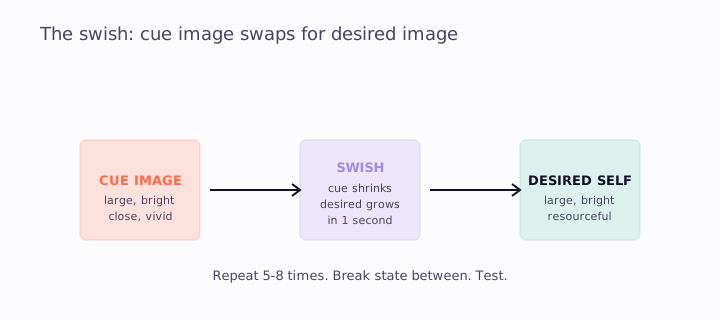
Most habits run on a sequence: trigger -> internal image -> behavior. The internal image is the part the conscious mind never inspects but the unconscious responds to. The swish intervenes precisely at the image step.
By repeatedly swishing the cue image into the desired self-image, you teach the unconscious that when the cue appears, the desired self appears with it. After enough repetitions, the cue can no longer fire the old image cleanly; the desired image keeps surfacing instead.
The 6-step swish protocol
- Identify the cue image. Ask: "What do you see in your mind just before you do the unwanted behavior?" Get the picture precise - distance, brightness, framing.
- Build the desired self-image. Not the desired behavior - the desired self. The version of the client who simply does not have this problem. Make it vivid and compelling.
- Set up the swish. Cue image large, bright, close. Desired self-image small, dark, in the lower corner.
- Swish. In under a second: cue shrinks and darkens to the corner; desired self explodes large and bright into the center. Add a sound effect ("swish") if it helps.
- Break state. Open eyes, look around the room, ask an unrelated question.
- Repeat 5-8 times. Each cycle should feel faster than the last. Test by trying to bring up the cue image deliberately; if it resists or pops into the desired self, the swish has taken.
Common use cases
- Habit change with visual triggers: smoking, nail-biting, snacking.
- Automatic stress responses: the moment of freezing before a phone call.
- Performance anxiety: the image of failing that intrudes before stepping on stage.
- Negative self-talk triggers: the image that precedes the inner critic firing.
What can go wrong with the swish?
- Too slow. If the cycle takes 3 seconds, you are visualizing, not swishing. Speed is what makes it work.
- Weak desired self. A vague "be confident" image will not displace a vivid cue image. Build the desired self with the same submodality detail you used for the cue.
- Wrong cue. If the client cannot reliably surface the image before the behavior, swishing the wrong thing produces no change.
- Ecology missed. If the unwanted behavior is doing important work (stress management, social signal), the swish may install but the behavior re-emerges in a different form. Check ecology first.
Frequently asked questions
How many repetitions does the swish need?
Typically 5-8 fast repetitions with a break state in between each. The swish should feel rapid (under one second per cycle); if it feels slow you are doing visualization, not swishing.
What if the cue image still appears after the swish?
Either the swish was too slow, the desired image was not vivid enough, or the cue image is doing important work the client is not ready to give up. Investigate ecology before forcing more repetitions.
Can the swish work on internal sounds?
Yes. Auditory swishes substitute an internal voice for an internal sound. Same principle, different channel. They are less common because most habit triggers turn out to be visual.
Is the swish the same as visualization?
No. Visualization rehearses a desired state; the swish actively replaces an unwanted automatic response with a desired self-image. The speed and the directional replacement are what makes it a swish.
How long does the effect last?
When well-installed, the swish tends to hold because it works at the level of automatic response, not conscious choice. Test it in real conditions within 48 hours; if it has not held, re-run the protocol.
What kinds of habits does the swish work best on?
Habits triggered by a clear, repeating internal image (reaching for a cigarette when stressed, biting nails when concentrating, freezing before a phone call). Habits without a clear visual trigger respond better to other techniques.
DIRECTORY
Find a swish-pattern trainer
Habit change is one of the most common reasons people work with NLP coaches.