What are submodalities?
Submodalities are the structural properties of internal representations. An internal image has brightness, size, distance, and color. An internal voice has volume, tempo, and direction. A body sensation has weight, temperature, and location. These properties are not the content - they are the format.
The discovery NLP rests on: changing the format changes the feeling. The brain reads the same content differently depending on how it is structured. A dim, distant memory of failure carries less emotional charge than a bright, close one of the same event.
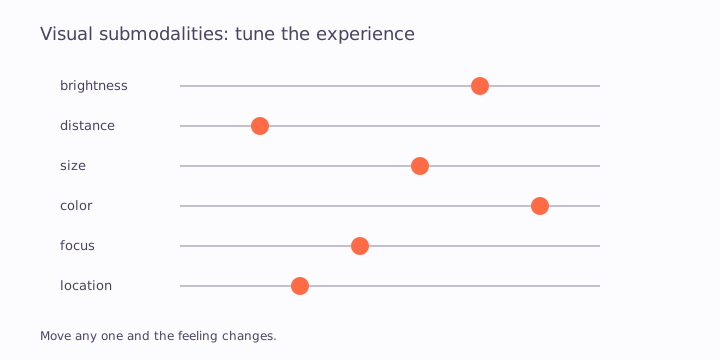
The standard submodality lists
Visual
- Brightness (bright -> dim)
- Distance (close -> far)
- Size (large -> small)
- Color (full color -> black-and-white)
- Focus (sharp -> blurry)
- Location (where in your visual field)
- Movement (still -> moving)
- Framed (bordered) or panoramic
- Associated (through your own eyes) or dissociated (watching yourself)
Auditory
- Volume (loud -> quiet)
- Tempo (fast -> slow)
- Pitch (high -> low)
- Direction (where the sound comes from)
- Distance (close -> far)
- Continuous or intermittent
- Mono or stereo
Kinesthetic
- Location (where in the body)
- Pressure (light -> heavy)
- Temperature (cold -> hot)
- Movement (still -> moving, direction)
- Texture (smooth -> rough)
- Size (small -> large)
- Duration (brief -> sustained)
Critical submodalities
The "critical submodalities" for any individual are the specific ones that produce the largest change when shifted. They differ by person and by issue. For one client, distance is the lever; dimming an image does nothing, but moving it from 2 feet away to 20 feet away dissolves the charge. For another, the lever is color.
The standard exploration: walk through the list, shift each submodality one at a time, and watch the client's physiology. The shifts that produce visible state change are the critical ones for that person.
The contrast exercise
A common discovery exercise:
- Recall something you are sure about. Notice its visual submodalities.
- Recall something you are unsure about. Notice the submodalities.
- Compare - what differs? Brightness? Distance? Position?
- Take something you want to feel more sure about and shift its submodalities to match the "sure" structure.
This single exercise reveals the structural difference between belief and doubt for that person. It is also the seed of many longer interventions: the swish, belief-change protocols, decision-strategy work.
What submodality work cannot do
- It cannot make harmful situations stop being harmful. It can change how the client carries the memory of harm, not the harm itself.
- It cannot replace deeper psychological work for trauma or grief. It is a useful adjunct, not a substitute.
- It can dim emotional signals that the client should be listening to. Use ecology checks.
Frequently asked questions
What's the difference between modality and submodality?
Modality is the broad sensory channel (visual, auditory, kinesthetic). Submodalities are the fine-grained qualities within each modality (brightness, distance, tempo, volume, location). Modality tells you what channel; submodality tells you how it is structured inside that channel.
Which submodalities matter most?
It varies by person. The 'critical submodalities' for any individual are the ones that produce the biggest change when shifted. Common candidates: brightness, distance, size, location, focus, color vs black-and-white. Calibrate to find the client's.
Can shifting submodalities cause harm?
Rarely from the shift itself, but dimming an important emotional response inappropriately can cost a client information. Submodality work should serve the client's outcome, not just produce instant relief.
Do submodalities change automatically over time?
Yes. Most memories naturally dim, recede, and lose color over years. Some memories resist this and stay as bright and close as the day they formed - usually traumatic ones. Submodality work can accelerate the natural process.
Can you work with auditory submodalities?
Yes. Volume, tempo, pitch, direction, distance, mono vs stereo. Internal-voice work often runs primarily on auditory submodality shifts.
How long does a submodality shift last?
When it produces a real change in how the experience feels, often immediately and durably. If the shift does not survive a break state and re-test, repeat the protocol or address ecology first.
DIRECTORY
Find a submodalities specialist
Most certified Practitioners can teach the basics; Master Practitioners do deeper structural work.